Welcome, Young Explorer!Imagine finding an old-looking treasure map during a visit to a beautiful nature park.
Would you follow it?
What if the map contained mysterious symbols, mathematical puzzles, and clues that could lead to something valuable?
Today, you are joining five friends on an unforgettable adventure.
Your mission is to follow their journey, understand the clues, and discover the secret waiting at the end of the trail.
But remember, a good explorer must be curious, careful, responsible, and respectful of nature.
How to Play
- Read all six phases of the story carefully.
- Pay attention to names, times, distances, directions, numbers, and important conversations.
- Remember the seven clues discovered during the adventure.
- Think logically before deciding what each clue means.
- Notice how the characters solve problems and make decisions.
- After reading the story, answer 15 randomly selected questions.
- Each question has four answer options, but only one is correct.
- Use the hints whenever you need help, and read the answer explanations to learn more.
Ready, explorer? Your adventure begins now!
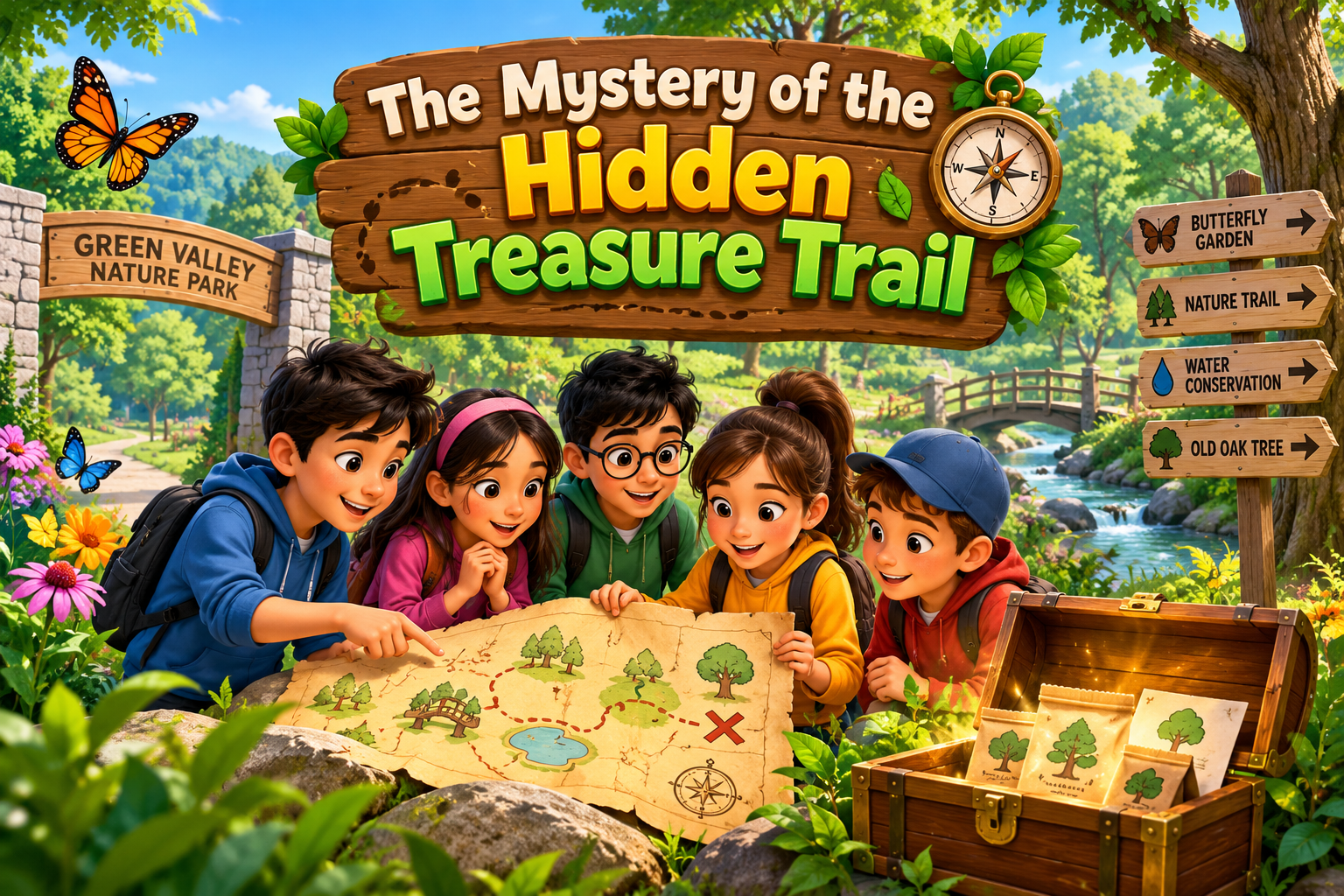
Phase 1: A Saturday Surprise
An exciting visit to Green Valley Nature Park
It was a beautiful Saturday morning.
Five friends from Class 6B were excited about their visit to Green Valley Nature Park, located just outside their town.
The park was famous for its tall trees, colourful flowers, walking trails, butterfly garden, and small lake.
The friends had been looking forward to this trip for several weeks.
Ayaan, aged 11, loved solving mysteries and noticing unusual details.
Tara, aged 12, enjoyed mathematics and number puzzles.
Rohan, aged 11, was interested in plants, animals, and protecting nature.
Diya, aged 12, was good at remembering instructions and organizing activities.
Kabir, aged 11, enjoyed reading maps and understanding directions.
Their science teacher, Mrs. Priya, had organized the visit as part of the school's Nature Learning Programme.
The group arrived at the park entrance at 9:00 AM.
Mrs. Priya explained the park's safety rules.
"Everyone must stay together, follow the marked paths, and avoid disturbing plants or animals."
She also reminded them not to enter restricted areas or pick up unfamiliar objects without permission.
At 9:15 AM, the students gathered near the park's visitor centre.
A park guide named Mr. Arvind welcomed them.
"Today, we have prepared a special activity for young explorers," he announced.
He held up an old-looking envelope.
Inside was a folded paper decorated with drawings of trees, butterflies, and a small wooden chest.
The heading read:
THE HIDDEN TREASURE TRAIL
The students became excited.
"Is there real treasure hidden in the park?" Ayaan asked.
Mr. Arvind smiled.
"That is something you will discover."
He explained that the treasure hunt was an official park activity.
The trail contained seven clues, and every clue would lead the students closer to their destination.
The students would follow the clues with Mrs. Priya and Mr. Arvind.
They were not allowed to leave the marked paths, open restricted gates, or disturb anything in the park.
Mr. Arvind handed the envelope to Diya.
Inside was the first clue.
The adventure had begun.
Phase 2: The First Three Clues
Clue 1: The Number Pattern
The first paper contained a number sequence:
4 – 8 – 12 – 16 – ?
Below it was written:
"Find the next number. Then look for the matching trail marker."
Tara examined the sequence.
"Each number increases by four," she explained.
The next number was 20.
The students looked around the visitor centre.
Several wooden trail markers stood near the entrance.
One was labelled 12.
Another was labelled 16.
A third was labelled 20.
"That's our marker!" Kabir said.
The group followed Mr. Arvind to marker 20, which stood beside a large banyan tree.
A small weatherproof clue box was attached to a wooden post.
Inside was the second clue.
Clue 2: The Direction Challenge
The second clue read:
"Face north. Turn right. Walk 100 metres along the marked path. Look for the place where colourful wings gather."
Kabir thought about the directions.
"If we face north and turn right, we'll be facing east."
Mr. Arvind confirmed that the marked path continued east.
The students walked 100 metres east.
They arrived at the park's beautiful butterfly garden.
Butterflies of different colours fluttered around flowering plants.
Rohan noticed a sign:
BUTTERFLY GARDEN — PLEASE DO NOT TOUCH THE BUTTERFLIES OR PICK THE FLOWERS
Near the entrance stood another wooden post.
Attached to it was the third clue.
Clue 3: The Time Puzzle
The clue said:
"A gardener begins watering plants at 9:30 AM and finishes 25 minutes later. What time does the gardener finish?"
Tara quickly worked out the answer.
"9:55 AM!"
Below the puzzle was another instruction:
"Find the information board showing this time."
The friends searched the permitted visitor area.
Diya spotted a board near the garden exit.
It displayed the park's daily gardening demonstration schedule.
One activity was listed at 9:55 AM.
Beside the board was a green arrow pointing toward the Nature Learning Centre.
"That's where we should go next," Ayaan said.
Mr. Arvind confirmed that they had solved the first three clues correctly.
The students continued along the marked path.
Phase 3: The Mysterious Footprints
A clue that almost caused confusion
At 10:10 AM, the group reached the Nature Learning Centre.
The centre displayed information about forests, wildlife, water conservation, and local plants.
Outside the building, the students noticed several footprints in a patch of damp soil beside the path.
Some prints were large.
Others were small.
Ayaan stopped.
"Look! Someone has walked through the mud. Maybe these footprints lead to the treasure!"
Kabir examined the ground.
The footprints continued toward a fenced maintenance area.
A sign on the fence read:
AUTHORIZED STAFF ONLY
Ayaan suggested following the footprints.
But Diya immediately reminded him of the park rules.
"We aren't allowed to enter restricted areas."
Rohan added, "The footprints could belong to park workers. We don't know whether they have anything to do with the treasure hunt."
Mrs. Priya agreed.
"An interesting observation is not necessarily a useful clue."
Mr. Arvind explained that maintenance workers had used that route earlier in the morning.
The footprints were unrelated to the treasure trail.
Ayaan realized that he had made an assumption without enough evidence.
The friends continued to the entrance of the Nature Learning Centre.
There, they discovered the fourth clue.
Clue 4: The Distance Challenge
The fourth clue contained a short message:
"You have walked 100 metres east to reach the butterfly garden. Your next marked route is 150 metres north. What is the total distance of these two trail sections?"
Tara added the distances.
100 + 150 = 250 metres.
Mr. Arvind explained that this was the total distance travelled along those two sections, not the straight-line distance between their endpoints.
The clue instructed them to follow the marked northern path for 150 metres.
The group began walking.
After completing the route, they arrived at a wooden bridge.
Below the bridge flowed a narrow stream.
The water was clear enough to see small stones beneath the surface.
A sign reminded visitors:
DO NOT THROW WASTE INTO THE STREAM
The friends stopped to admire the view.
But another challenge was waiting.
Phase 4: The Bridge and the Missing Clue
An unexpected problem
At 10:35 AM, the students reached the wooden bridge.
They expected to find the fifth clue attached to a post near the bridge entrance.
But the clue holder was empty.
"The clue is missing!" Diya exclaimed.
Ayaan looked around.
"Maybe someone took it."
"Or maybe it fell," Rohan suggested.
Mr. Arvind examined the holder.
The clip that normally secured the paper was loose.
He explained that strong wind earlier that morning might have dislodged the clue.
However, they could not be certain what had happened.
Mrs. Priya reminded the children not to climb over the bridge railing or search near the stream.
The group stayed on the marked path.
Kabir noticed a laminated paper lying beside a bench a few metres away.
He pointed it out to Mr. Arvind.
The guide picked it up.
It was the missing fifth clue!
"Good observation, Kabir," he said.
The paper was dry and undamaged.
The friends gathered around as Mr. Arvind read the message.
Clue 5: The Water Conservation Puzzle
"A leaking tap wastes 2 litres of water every minute. How much water would it waste in 10 minutes?"
Tara calculated:
2 × 10 = 20 litres.
Rohan looked concerned.
"That's a lot of water to waste in such a short time."
Mrs. Priya explained that even small leaks can waste significant amounts of water when they continue for long periods.
The clue continued:
"Find the place where visitors learn how to save water."
The students checked the park's visitor map.
The Water Conservation Corner was marked near the stream, on the other side of the bridge.
The group crossed the bridge carefully, following Mr. Arvind.
At the Water Conservation Corner, they saw demonstrations of rainwater harvesting, water-saving taps, and responsible water use.
A sign explained how rainwater collected from rooftops could be stored and used for suitable purposes.
Near the display stood a wooden box containing the sixth clue.
Phase 5: The Final Challenge
Clue 6: The Logic Puzzle
At 10:50 AM, the friends opened the sixth clue.
It contained a short puzzle.
"Three places are marked on the treasure map: the Rose Garden, the Birdwatching Point, and the Old Oak Tree."
"The treasure is not near the flowers."
"It is not at the place where visitors watch birds."
"Which location should you investigate next?"
Dev was not part of this adventure, but Ayaan remembered something his classmates often said:
"When you don't know the answer, remove the possibilities that cannot be correct."
The friends considered the three locations.
The Rose Garden was associated with flowers.
The Birdwatching Point was where visitors watched birds.
That left the Old Oak Tree.
"The answer must be the Old Oak Tree!" Ayaan said.
Mr. Arvind checked the map.
The Old Oak Tree was located along the marked nature trail.
The group followed the guide toward it.
After a short walk, they reached a magnificent oak tree with a wide trunk and spreading branches.
A wooden sign explained that the tree was estimated to be more than 80 years old.
Rohan admired it.
"Imagine how many birds and insects have used this tree for shelter over the years."
Near the tree stood a small information board.
Attached to the board was the seventh and final clue.
Clue 7: The Final Message
The final clue read:
"The greatest treasure is not always gold or silver."
"It grows without asking for money."
"It gives shade, supports life, and helps keep our world healthy."
"Look beside the learning sign, where tomorrow's forest begins."
The friends looked around.
Ayaan noticed a small wooden chest placed beside a sign reading:
YOUNG FOREST PROJECT
Mr. Arvind confirmed that this was the final destination.
The chest was part of the official treasure-hunt activity.
He invited the students to open it.
Everyone gathered around.
What could be inside?
Gold coins?
Jewellery?
A special prize?
Diya carefully lifted the lid.
Inside were five packets of native tree seeds, five small certificates, and a handwritten message.
The message said:
"The greatest treasure is a healthy planet. Protect nature today, and you help create a better tomorrow."
For a moment, the friends were silent.
Then Rohan smiled.
"The treasure is something we can help grow!"
Mr. Arvind explained that the seeds were part of the park's Young Forest Project.
Each packet contained seeds from native tree species suitable for the park's conservation programme.
The students would help plant them in a designated area under the supervision of park staff.
The treasure was not money or jewellery.
It was an opportunity to contribute to something valuable for the future.
Phase 6: The Greatest Treasure
A discovery worth remembering
At 11:15 AM, the treasure hunt officially ended.
Mr. Arvind congratulated the five friends.
"You solved all seven clues without leaving the marked paths or disturbing the environment."
Mrs. Priya asked the students what they had learned.
Tara spoke first.
"Mathematics helped us solve the number pattern, calculate time, add distances, and understand how much water a leaking tap could waste."
Kabir added, "Directions and maps helped us find the correct places."
Diya smiled.
"Following safety rules was important, especially near the restricted area and the stream."
Ayaan thought about the footprints.
"I learned that something unusual isn't automatically part of a mystery. We should check the facts before making assumptions."
Rohan looked at the packets of seeds.
"And I learned that protecting nature can be more valuable than finding money."
Mr. Arvind nodded.
"Every one of you contributed something important."
He then explained the next activity.
The group would plant their seeds in a designated section of the Young Forest Project.
Each student would receive one packet.
The planting activity was scheduled to begin at 11:30 AM.
Before planting, the park staff demonstrated how to prepare the soil, place the seeds at an appropriate depth, and water them carefully.
The children followed the instructions.
They planted their seeds under supervision and placed small identification markers beside the planting spots.
Mr. Arvind explained that planting a seed did not guarantee it would grow into a healthy tree.
Seeds needed suitable conditions, care, and time.
The park's conservation team would monitor the planting area.
At 12:00 PM, the activity was completed.
The students washed their hands and gathered near the visitor centre.
Mrs. Priya asked one final question.
"How long did our treasure hunt last?"
Diya checked her notes.
They had started at 9:15 AM and finished at 11:15 AM.
"Exactly two hours!" she answered.
"And how much time did we spend on the planting activity?" Mrs. Priya asked.
"Thirty minutes," Tara replied.
The friends then enjoyed their packed lunches in the designated picnic area.
Before leaving, they checked that no litter had been left behind.
At 12:45 PM, the group boarded the school bus for the return journey.
As the bus moved away from Green Valley Nature Park, Ayaan looked through the window.
"I thought we were going to find a chest full of gold," he said.
Kabir laughed.
"We did find a chest!"
"But the treasure was different," Diya replied.
Rohan smiled.
"Maybe one day we'll come back and see the trees that grow from our seeds."
Tara looked at the certificate in her hands.
"It was worth solving all those puzzles."
The five friends had started their day searching for hidden treasure.
They returned with something even more valuable.
Knowledge.
Friendship.
Confidence.
And a better understanding of how small actions can help protect the natural world.
What did the adventure teach us?
Think before making assumptions
The footprints looked mysterious, but they were unrelated to the treasure trail.
Mathematics is useful in everyday life
Number patterns, time calculations, distances, and measurements helped the friends complete their adventure.
Safety comes before curiosity
The students followed marked paths, respected restricted areas, and stayed away from unsafe places.
Teamwork makes challenges easier
Every friend contributed a different skill.
Nature deserves our care
Clean water, healthy trees, and protected habitats are valuable resources.
The greatest rewards are not always money
Learning, friendship, and contributing to a better future can be meaningful rewards.
Congratulations, Young Explorer!
You have completed The Mystery of the Hidden Treasure Trail.
But your adventure isn't over yet!
Can you remember all seven clues?
Do you know which observations were important and which were misleading?
Can you solve the mathematical challenges without looking back at the story?
And can you explain why the hidden treasure was so special?
Your next challenge is waiting.
Answer the questions and discover how carefully you followed the treasure trail!